
Cart is empty
ABOUT Ni-MH
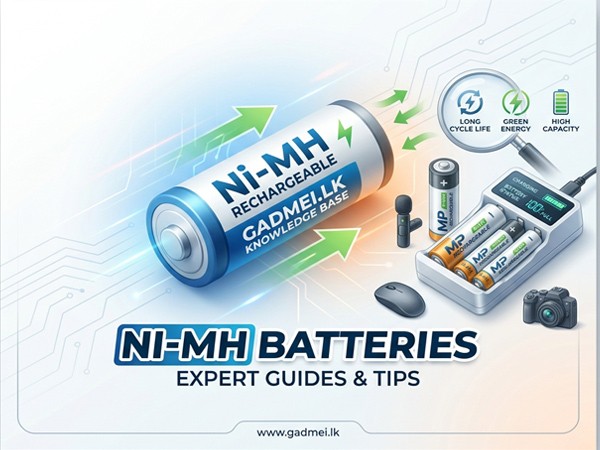
NiMH stands for Nickel-Metal Hydride. It is a widely used rechargeable battery chemistry designed to serve as a direct, reusable replacement for standard 1.5V alkaline single-use batteries.
Core Construction & Chemistry
A standard NiMH cell operates at a nominal voltage of 1.2V and consists of three main active components:
-
Positive Electrode (Cathode): Made of Nickel Hydroxide Ni(OH)2
-
Negative Electrode (Anode): Made of a Hydrogen-Absorbing Metal Alloy (a specialized mixture of metals like lanthanum, cerium, nickel, and manganese).
-
Electrolyte: An alkaline solution of Potassium Hydroxide KOH
During charging, hydrogen ions are driven from the positive electrode into the metal alloy of the negative electrode, where they are stored as metal hydrides. When discharging to power a device, hydrogen flows back, releasing electrons to generate electrical current.
Key Advantages of NiMH Chemistry
-
Higher Energy Capacity: Delivers 2 to 3 times the capacity of older NiCd (Nickel-Cadmium) batteries of equivalent size.
-
Cadmium-Free (Environmentally Safer): Replaced toxic cadmium with non-toxic hydrogen-absorbing alloys, making them easier to recycle and less hazardous to the environment.
-
Minimal Memory Effect: Unlike NiCd batteries, NiMH cells do not suffer from severe memory loss. You do not need to discharge them completely before recharging.
-
High-Drain Output: Low internal resistance allows them to deliver steady high current continuously, making them ideal for power-hungry gear like camera flashes, wireless microphones, and motorized toys.
Limitations to Keep in Mind
-
Self-Discharge Rate: Standard NiMH batteries lose 1% to 2% of their stored charge per day when sitting idle on a shelf (though low self-discharge "LSD" variants reduce this significantly).
-
Heat Sensitivity: NiMH cells generate internal heat during fast charging. Overcharging them damages cell capacity, which is why smart chargers with temperature and voltage monitoring (-\Delta V) are recommended.
-
1.2V vs 1.5V Nominal: While alkaline batteries start at 1.5V and rapidly decline down to 0.9V, NiMH holds a flat output near 1.2V for almost 80% of its discharge curve before dropping off.
Expert tips for getting maximum performance, reliability, and lifespan out of NiMH (AA and AAA) rechargeable batteries:
1. Smart Charging Practices
-
Use a Microprocessor-Controlled "Smart" Charger: Avoid cheap "dumb" timer chargers. Smart chargers monitor individual cell voltage and temperature, using - Delta V (negative Delta V) detection to cut off power the exact moment a cell reaches 100% capacity.
-
Calculate Standard Charge Times: If using a basic manual charger, calculate safe charge duration using the standard efficiency formula:
-

-
Avoid Excessive Heat: Heat is the primary enemy of NiMH chemistry. If batteries feel hot to the touch (over 45°C to 50°C) during charging, slow down the charge rate or let them cool.
2. Matching and Pairing Rules
-
Never Mix and Match: Keep batteries in dedicated, matched sets of the exact same brand, age, capacity (mAh), and charge status.
-
Avoid Polarity Reversal: In multi-battery devices (like a 4-AA wireless mic or flashlight), mixing a fully charged battery with a weak one can cause the weaker battery to drop below 0V, driving it into reverse polarity and permanently ruining the cell.
-
Never Mix Chemistries: Do not combine NiMH rechargeable batteries with single-use alkaline or heavy-duty zinc-carbon cells in the same device.
3. Usage & Capacity Optimization
-
High-Drain vs. Low-Drain Selection:
-
High-Capacity Cells (2500mAh – 3000mAh AA): Ideal for camera flashes, wireless microphones, motorized RC toys, and high-intensity LED torches.
-
Standard/Low-Self-Discharge Cells (1250mAh – 2000mAh AA / 800mAh AAA): Ideal for computer mice, keyboards, TV remotes, desk clocks, and digital thermometers.
-
-
Avoid Deep Discharges: Do not run NiMH batteries down until a device completely shuts off or dies. Draining a cell below 1.0V causes structural degradation to the internal hydrides.
4. Storage & Maintenance Tips
-
Perform Refresh Cycles: If NiMH batteries have been sitting unused for months, run them through 2–3 full charge/discharge cycles on a smart charger to restore lost capacity.
-
Store at Room Temperature: Store unused cells in a cool, dry place (15°C to 25°C). Avoid keeping them in hot vehicles or direct sunlight.
-
Store with Partial Charge: When storing batteries for long periods, keep them charged to around 40%–50% rather than storing them completely drained.
Buy Ni-MH batteries
https://www.gadmei.lk/product/RECHARGEABLE-BATTERY-AA-MP-3000MAH-2PACK/4319
https://www.gadmei.lk/product/RECHARGEABLE-BATTERY-AAA-MP-1250MAH-2PACK/4320